







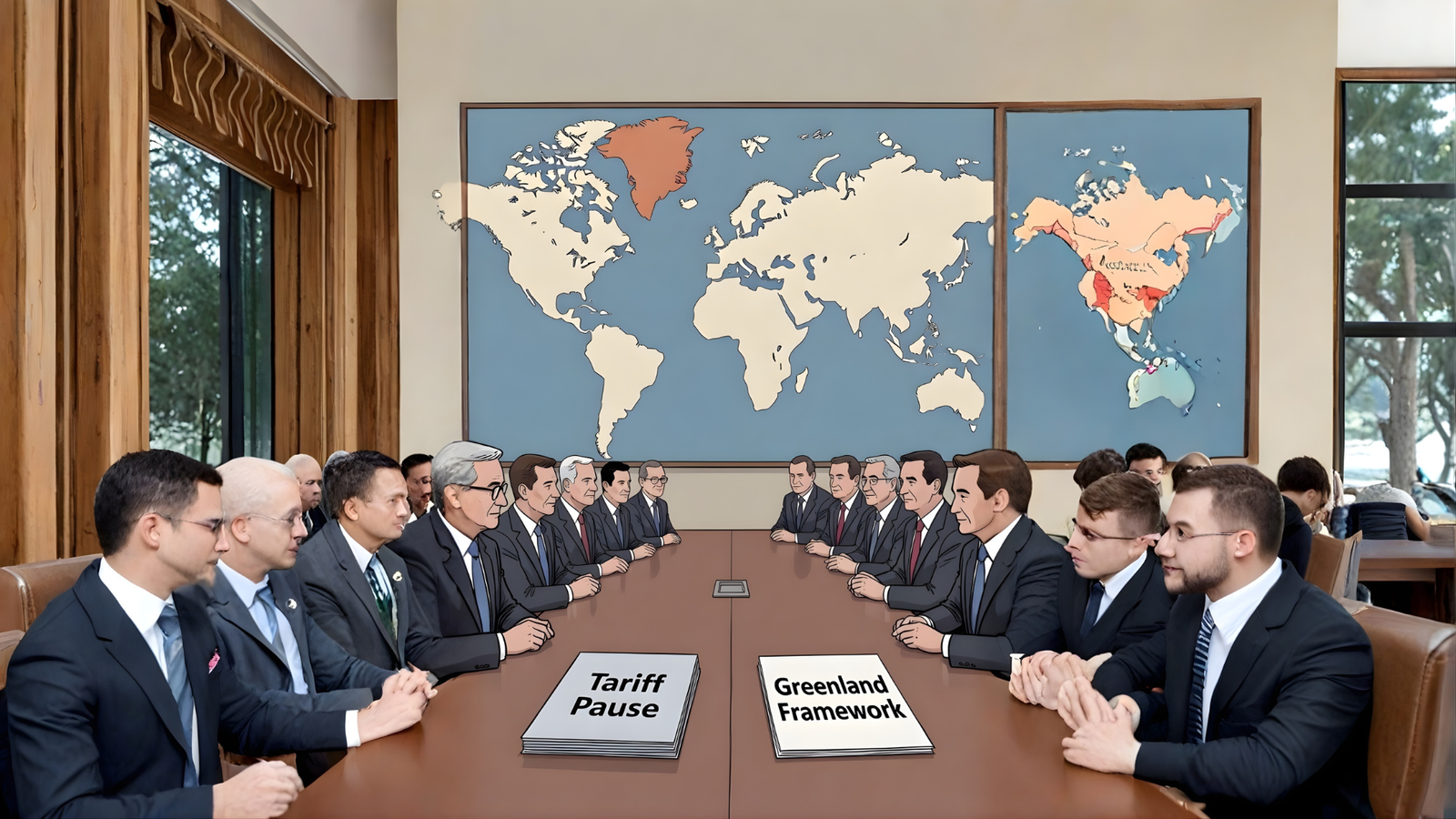
Greenland entered global trade discussions wearing a tariff deadline like an accessory nobody had formally requested. President Donald Trump announced Wednesday that eight European countries would temporarily escape looming American tariffs.
Only days earlier, Trump had promised a ten percent tariff starting February first. Denmark, Britain, and several NATO partners were clearly listed as intended recipients. The message felt unmistakable, if slightly theatrical. Cooperation would be rewarded. Resistance would become steadily more expensive by June.
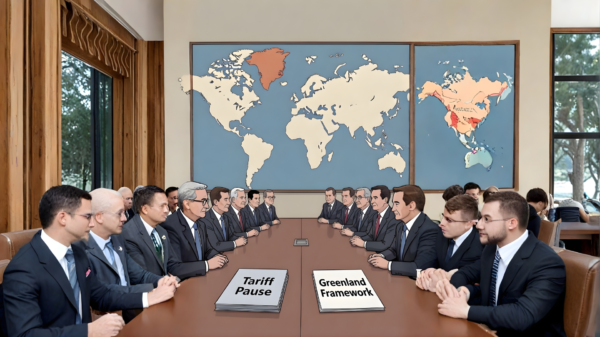
Then came a meeting with NATO Secretary General Mark Rutte. Trump later described the discussion as productive and forward-looking. Productive enough, apparently, to justify a sudden pause. A flexible “framework” emerged, involving Arctic cooperation and future strategic alignment.
Markets reacted with visible relief rather than careful confidence. Stocks climbed quickly, celebrating delay instead of clarity. Certainty had not arrived. Risk merely stepped outside briefly to reassess.
Europe responded with calculated restraint. The European Union’s parliament halted final approval of a key trade agreement. Leaders scheduled an emergency summit, rediscovering coordination as a practical necessity.
Speaking later in Davos, Trump clarified his position publicly. He still wanted the United States to control Greenland. Military force, however, was described as unnecessary. Negotiations would begin immediately, and politely.
Denmark replied with controlled firmness. Its foreign minister rejected talks that compromised fundamental principles. Sovereignty, he explained, was not a negotiable commodity. Diplomatic temperatures dropped several degrees.
Back in Washington, additional officials were assigned overlapping responsibilities. Vice President JD Vance and Secretary of State Marco Rubio would handle Greenland discussions. They were also managing Ukraine, Russia, and several unresolved global concerns.
Rubio’s portfolio quietly expanded in the background. Alongside diplomacy, he carried interim security and archival duties. The accumulation raised curiosity, though objections remained notably absent.
For now, tariffs remain paused, pending further conversations and gestures. The calm feels temporary, carefully staged, and politically reversible. In modern geopolitics, Greenland has become less a place and more a strategic pause.
